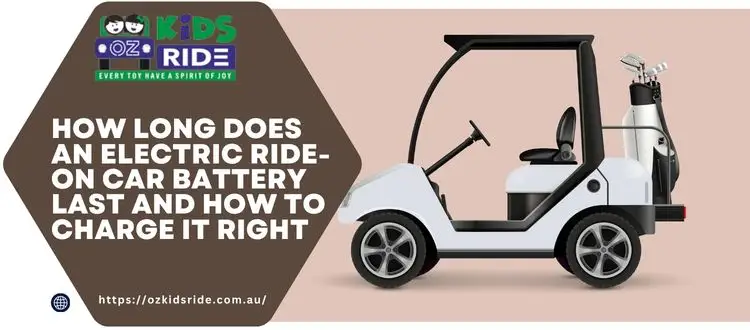
There is nothing quite like the joy on a child’s face when they hop behind the wheel of their very own mini vehicle. Whether cruising around the driveway in sleek Ride On Cars, tearing up backyard trails in rugged 24V Ride On Jeeps, or hauling garden treasures with a heavy-duty Trailer with Tractor, outdoor play provides endless entertainment.
However, nothing brings playtime to a sudden halt faster than a dead battery.
If you want to keep the adventures rolling without interruption, understanding how your
electric ride-on car battery works—and how to care for it—is essential. At OZ Kids Ride, we offer high-performance vehicles across Australia designed for pure fun and innovation. To help you get the absolute most out of every drive, here is our complete guide on battery life, charging best practices, and long-term maintenance.
How Long Does an Electric Ride-On Car Battery Last Per Charge?
On average, a fully charged electric ride-on car battery provides between 1 to 2 hours of continuous run time. However, the actual duration depends heavily on several real-world factors:
- Battery Voltage & Amp Hours (Ah): Standard 12V models usually provide around 45 to 90 minutes of ride time, while larger 24V setups (like our high-capacity 24V 14Ah Buggies or Toyota Hilux UTEs) offer longer run times and higher torque.
- Rider Weight & Terrain: Driving on smooth concrete or asphalt requires far less power than tackling grass, gravel, or steep inclines. Carrying heavier loads—especially when towing cargo behind a Trailer with Tractor—will draw more power from the battery.
- Vehicle Features: Built-in headlights, Bluetooth sound systems, power-steering motors, and 4WD drive modes consume additional power during operation.
What Is the Overall Lifespan of an Electric Ride-On Car Battery?
With proper care, a typical sealed lead-acid or lithium-ion electric ride-on car battery lasts between 1 to 3 years (or roughly 300 to 500 charge cycles) before requiring replacement.
If you notice that the vehicle loses power after only 10 to 15 minutes of use, or if the charger indicator light changes rapidly from charging to full, it is likely time to source replacement spare parts or a new battery pack.
How to Charge Your Electric Ride-On Car Battery Right
Following correct charging habits is the single most effective way to extend the life of your battery and prevent permanent cell damage.
1. The Initial Charge Is Critical
When you unbox a brand-new vehicle from OZ Kids Ride, always charge the battery fully for 12 to 18 hours before its very first use (never exceed 24 hours). Even if the battery appears to have power out of the box, an initial full charge conditions the chemical cells for maximum capacity.
2. Follow Standard Recharge Times
- Routine Recharge: After regular play, charge the battery for 8 to 12 hours.
- Avoid Overcharging: Leaving a standard charger plugged in for more than 18 to 20 continuous hours can overheat the electric ride-on car battery, causing it to swell or lose charge memory.
3. Never Let the Battery Drain to Absolute Zero
Plugging in the vehicle after every ride is far better than waiting until the battery is completely flat. Deep-discharging a lead-acid battery weakens its internal plates, significantly shortening its total lifespan.
Pro-Tips for Battery Maintenance and Storage
Whether you own dynamic drift go-karts, classic
Ride On Cars, high-powered Ride On Jeeps, or utility farm models like a Trailer with Tractor, follow these storage guidelines to keep your ride road-ready:
- Top Up During Storage: If the vehicle is parked during winter or stored for extended periods, charge the battery at least once every 3 to 4 weeks. Batteries naturally self-discharge over time; letting them sit empty for months can permanently kill them.
- Store in a Climate-Controlled Area: Keep batteries in a dry, cool environment away from direct freezing temperatures or extreme summer heat.
- Disconnect When Idle: If you plan on leaving the vehicle unused for weeks, disconnect the battery harness to prevent minor electronics from slowly draining the charge.
Two Kinds of “How Long” — and Both Matter
When people ask about an electric ride-on car battery, they’re usually asking one of two different things.
Runtime is how long the ride-on runs on a single charge. Lifespan is how many years the battery itself survives before it needs replacing. Good charging habits improve both, which is exactly why they’re worth getting right from day one.
Runtime: What to Expect Per Charge
Most of the Ride On Cars we stock use a 12V or 24V sealed lead-acid battery, and a healthy one will give you roughly 45 to 90 minutes of continuous driving. Larger-capacity packs — like the 24V 14Ah battery in our KING OF UTVs 2-seater buggies — sit at the upper end of that range because there’s simply more stored energy to draw from.
That figure moves around a lot in real life, though. Your child’s electric ride-on car battery will drain faster if:
- The surface is soft. Grass, gravel, sand and wet lawn force the motors to work far harder than smooth concrete. A ride-on that manages 90 minutes on a driveway might manage 40 on a backyard.
- There’s a passenger. Two-seater models carry close to double the load. Our Ride On Jeeps and 2-seater buggies are built for it, but the battery still empties sooner.
- Hills are involved. Climbing is the single most demanding thing you can ask of the motors.
- It’s cold. Winter mornings in Brisbane are mild, but anywhere colder will shave noticeable minutes off the runtime.
- Lights, music and sound effects are running. Minor on their own, but they add up across an afternoon.
- The kids love high speed. Low gear is dramatically more efficient than full throttle.
A
Trailer with Tractor set is the clearest example of all this. The moment the trailer is loaded with toys, soil or a very determined sibling, the electric ride-on car battery is doing considerably more work — and the runtime drops accordingly. That’s normal, not a fault.
Lifespan: How Many Years You Should Get
With sensible care, a sealed lead-acid electric ride-on car battery typically lasts one to three years, and plenty of well-looked-after batteries run past that.
The difference between a battery that dies in eight months and one that’s still going strong in year three almost always comes down to charging habits — not the brand, not the price, and not how often the kids ride.
Warning Signs Your Battery Is Near the End
Watch for these:
- Runtime has collapsed — a full charge now lasts fifteen minutes instead of an hour
- Noticeably slower top speed, particularly on inclines
- It won’t hold charge overnight after a complete charging cycle
- Swelling, cracking or leaking on the battery casing — stop using it immediately and replace it
- Charging times have changed dramatically in either direction
A clear drop in runtime that doesn’t recover after a proper full charge usually means replacement time. It’s an inexpensive fix compared with the ride-on itself, and the correct battery will have your child back out on the driveway the same day.
Habits That Quietly Extend Battery Life
- Start younger or less confident drivers in low gear — gentler on the battery and safer
- Respect the stated weight limit for the model
- Keep tyres clean and free of tangled grass, which adds resistance
- Encourage smooth driving over constant stop-start throttle bashing
- Switch the ride-on off when it’s parked, not just left idle
- Unload the trailer on your Trailer with Tractor set when it isn’t being used for hauling
Need Spare Parts, Upgrades, or Local Service?
At
OZ Kids Ride, our mission is simple: providing Australian families with the best selection of premium ride-on toys. We deliver across Australia and offer local inspection, pickup by appointment, assembly services, and genuine spare parts from our Springfield Lake, QLD location.
If your vehicle needs a fresh electric ride-on car battery, a replacement charger, or an upgraded battery kit, browse our full collection at
ozkidsride.com.au or contact our team at
[email protected] / 0466 853 334.
Here is a tailored set of 7 Frequently Asked Questions (FAQs) written specifically for OZ Kids Ride under your requested title.
Frequently Asked Questions (FAQs)
1. How long does a ride-on car battery last on a full charge?
On average, a fully charged 6V, 12V, or 24V ride-on car battery provides 1 to 2 hours of continuous runtime. Actual playtime depends on factors like the voltage of the vehicle, the rider’s weight, the terrain (e.g., grass vs. flat pavement), and whether features like Bluetooth speakers or headlights are being used.
2. How long should I charge my kids’ ride-on car battery?
Important: Never leave the battery on the charger for more than 20 consecutive hours, as overcharging can permanently degrade the battery cells.
3. What is the total lifespan of an electric ride-on car battery?
With proper care and routine charging, a standard lead-acid or lithium-ion ride-on car battery typically lasts between 1 to 3 years (or roughly 300 to 500 charge cycles). If you notice the car running out of power significantly faster than usual, it may be time to source a replacement battery.
4. Can I leave the ride-on car plugged in overnight or all the time?
It is not recommended to leave the charger connected permanently unless you are using a smart trickle charger with an automatic shut-off feature. Standard chargers continue delivering voltage even when full, which causes overheating and shortens the battery’s overall lifespan. Unplug the charger once the recommended time limit (8–12 hours) is reached.
5. How should I care for the battery during winter or extended storage?
If the vehicle won’t be used for several weeks or during winter:
-
Charge the battery fully before storing the car away.
-
Disconnect the battery terminal connections to prevent passive power drain.
-
Recharge the battery at least once every 30 days during storage to prevent the battery from losing its charge entirely.
6. Why is my ride-on car battery not holding a charge?
If the car loses power after just a few minutes of use, common causes include:
-
Sulfation from deep discharge: Letting a lead-acid battery sit completely flat for too long damages the cell plates.
-
Faulty Charger: Check if the charger indicator light changes when plugged into the car.
-
Loose Wiring: Ensure all wire connectors beneath the seat or hood are securely fastened.
7. How do I know when the battery is fully charged?
Most chargers supplied with electric ride-on cars feature a dual-color LED indicator light:
If your model does not have an indicator light, follow the timed guidelines (max 12 hours for regular maintenance charges).